
 Posts
Posts


 |
| Phosphorus Bombs over Gaza City, January 2009 |
This post offers a fifth anniversary commemoration of that tragic and highly destructive event. It offers a substantive audio presentation recounting the pivotal events in the history of Israel/Palestine from 1947 to the present through the reflections of a number of informed and articulate commentators. This post also includes a modified version of an essay published in December 2010 as a two-year commemoration of the assault and the events leading up to it.
Slouching Towards Gaza can be streamed using the media player above. A broadcast quality mp3 file (192 kbps) is available for download here. CD quality (128 kbps) and LoFi audio are also available for download here.
Production Notes
The Voices
Chris Hedges (New York Society for Ethical Culture, January 2009)
Richard Falk (Middle East Monitor Conference, London, Dec. 2010)
Sara Roy (University of Sydney, Ideas, October 2008)
Tanya Reinhart (University of Sydney, Ideas, October 2006)
Mustafa Barghouti (TUC Radio, March 2004)
Edward Said (U. of California, Berkeley, March 2003)
David Ben-Gurion (June 1947, Talking History Archive, Dec. 2004)
Ilan Pappe (University of Bern, Switzerland, November 2012)
Robert Fisk (Interview with Cindy Sheehan, September 2010)
Eyal Weizman (KPFA, Against the Grain, April 2009)
Mads Gilbert (Unusual Sources, January 2010; Muslim Perspectives, January 2010; Sounds of Dissent, Nov. 2012)
The Poetry
Suheir Hammad. Gaza Suite. 1: Gaza
Vincent Di Stefano. Careful Now (Excerpt). Music composed and performed by Nico Di Stefano
The Music
Gilad Atzmon and Orient House Ensemble. Dal'Ouna on the Return
Rim Banna. The Wall
Yggdrasil. Al Dabaran
Sirocco. Nomads
The Ida Raichel Project. Azini (Comfort me)
Digital Samsara. C#
Jocelyn Pook. Migrations
Steve Kahn and Rob Mounsey. I See a Long Journey
The Herd. Kids Learn Quick
Digital Samsara. 7am
Outlandish and Sami Jusuf. Try not to Cry
Produced by
Vincent Di Stefano
With thanks to Maria Gilardin of TUC Radio for generously making available audio of Mustafa Barghouti and Edward Said lectures
AND WHAT ROUGH BEAST SLOUCHES TOWARDS GAZA?
Operation Cast Lead and the Dismembering of a People
 |
| Phosphorus bombs at UN Complex, Gaza City, January 2009 |
In early January 2009, two lone voices braved the Australian
media to offer a differing view to that given by Government spokespersons
regarding Operation Cast Lead, the
22-day assault of Israel on Gaza that began on December 27th 2008.
The first was that of Greens Leader, Senator Bob Brown. He urged Julia Gillard
to speak out against the “violent and disproportionate action by Israeli leaders.”
More pointed were the comments of Julia Irwin, Federal MP for the NSW seat of
Fowler. In an article published in the Sydney Morning Herald at the time, she used
metaphor to draw our attention to the travesty that was occurring in Gaza:
“It all
reminds me of an old story from the days of the Roman Empire. The emperor
Nero
was upset that his prized lions were being distressed by Christians, who ran
away from them in the Colloseum. Nero ordered that at the next circus, a
Christian was to be buried up to his neck in the sand to make things easier for
the lions. When the lions entered the ring, the biggest and the meanest saw the
hapless condemned, swaggered over and stood astride the Christian’s head,
roaring for approval from the crowd. At that moment, the Christian craned his
neck and bit off the lion’s testicles. The crowd was shocked. “Fight fair!
Fight fair!” they yelled.”
Israel’s attack upon Gaza was met with a curious
indifference by most of the so-called leaders of Western nations. As acting
Prime Minister of Australia at the time, the ill-informed Julia Gillard refused
to criticise, let alone condemn the actions of Israel. Supposedly speaking on
behalf of the Australian people, she said: “Australia recognises the right of
Israel to defend itself.” That comment was made on the third of January 2009,
by which time it was widely known that 430 Gazans had already been killed and
2,300 wounded in 750 individual strikes carried out by air and by sea over the
previous five days.
Five years ago, we witnessed a stone-hearted disregard of the
humanity of those living in one of the most densely populated regions on the
planet by an unspeakably powerful military force. How is it that
politicians can so casually intone, “Israel has a right to defend itself”? Defend
itself from what? From the miserable Qassam rockets that vent the rage of an
immiserated group of Palestinian men, many of whose families have lost sons,
daughters, freedoms and lands since the military occupation of Gaza by Israel
that began in 1967? From the petulant stones hurled by boys and young men at
the supremely armoured Merkava tanks that have blown apart their communities
and knocked down their family homes?
There is much that underlies the grief and resentment that
sears the minds of invulnerated Palestinians, much that has been ignored,
suppressed and dismissed by those who would tell us what we should believe. Operation Cast Lead could not have
happened without the widespread acceptance of a view that dismisses the
essential humanity of the Palestinian people. How is it that so many in the
West have come to perceive the Palestinians as a hostile race, a violent
people, an unruly group with whom any reasoned and reasonable dialogue is
impossible?

The late Edward Said spent most of his adult life in an
impassioned quest to awaken our collective understanding to what has happened
to the people of Palestine since their traditional lands were handed over to the
newly created state of Israel in 1948 even as the embers of the Second World
War had yet to cool. In a lecture delivered at the University of California at
Berkeley eight months before he died in 2003, Edward Said reflected on the
sorry fate of Palestinians since 1967:
“The
thirty-five year old military occupation, now the longest and most brutally
sustained in modern history has taken a terrific toll in the human condition of
the Palestinians at every level. In fact, short of genocide itself, I cannot
think of a single one of their human rights as a people that has not been
violated with a kind of refined viciousness designed to dehumanise, break
their spirit and humiliate them to a degree that is, even to someone who has
been carefully but helplessly aware of what has been taking place, simply
stupefying.
What
has made it worse is how much of this has been wilfully shielded from
witnessing eyes by propaganda about fighting for survival and against
terrorism, claims that in any other instance, would defy the credulity of the
most gullible intelligence.”
Things have changed little since Said voiced these thoughts.
The past ten years have seen a deepening rather than an easing of the plight
of the people of Palestine, and more particularly, of the inhabitants of Gaza.
Edward Said was no armchair academic. He was a driving force
in the creation of the Palestinian National Initiative, a democratic movement
committed to providing Palestinians with an alternative identity to that
offered by Yasser Arafat and his Fatah inner circle. Among Said’s collaborators
in that project was Mustafa Barghouthi, a Palestinian doctor. In an article written two weeks after Israeli troops pulled out of a ruined Gaza in January
2009, Barghouthi offers a weepingly beautiful portrait of the Palestinian
people and a clear restatement of both their identity and the character of
their struggle. He reflects: “The main reason so much effort is put into distorting
the character of Palestinians is that if the world were to really know what is
going on here, the collective emotion would shift from apathy toward our
struggle to one of anger at our oppressor.”
One cannot understand the grievousness of what has happened
in Gaza without understanding the depth of dispossession and the degree of
oppression to which Palestinians have been subjected since the United Nations
partitioned the British-ruled Palestine Mandate in November 1947. According to
UN General Assembly Resolution 181, Israel was to be apportioned 55% of the
mandated territory while the Palestinians were to be apportioned 45%. That
never eventuated. Even before the Israeli land acquisitions of the Six Day War
in 1967, the new state of Israel had sequestered 78% of Palestinian lands.
 | |
| Uprooted Palestinians |
Between 1947 and 1951, more than 400 Palestinian villages
were totally destroyed. As Jewish immigrants poured in from all over the world,
nearly a million Palestinians were made homeless. Attacks by the Jewish army,
the Haganah, and the ruthless Irgun, a militia group headed by Menachem Begin
caused a massive exodus of Palestinians from their traditional lands. Reprisals
occurred, the slaughters continued, waves of Palestinian refugees fled into
neighbouring countries, and the Israelis took control of more lands. The
slaughter of 120 Palestinians at Deir Yassin on April 9th 1948 and
of 200 Palestinians at Tantura on May 15th 1948 were the earliest in
a series of blood-lettings that extended from the Naqba, the Great Catastrophe,
to the Sabra and Shatila massacres in Lebanon in 1982, the al Aqsa
mosque massacre in 1990, the bloodbath at Jenin Refugee Camp in 2002, and most
recently in the 1,400 Palestinian deaths that occurred during Operation Cast Lead.
The Soured Election
The more direct antecedents of Operation Cast Lead lie
in the Palestinian elections of January 2006. These elections were largely
driven by the Bush Administration in co-operation with the newly elected
Mahmoud Abbas, who took over the presidency of the Palestinian National
Authority after the death of the decrepit and opportunistic Yassar Arafat,
founder of Fatah. Investigative journalist Chris Hedges comments on life in Gaza at that time: “Gaza, ruled by warring factions, warlords, clans, kidnapping
rings and criminal gangs, had descended into chaos under Mahmoud Abbas’ corrupt
Fatah-led government”.
Things did not go according to plan in those elections. On
January 26th 2006, Hamas won 56% of the seats in the Palestinian Legislative
Council. The US and Israel took immediate steps to “correct” the situation.
Together with the European Union, Russia and the United Nations, the US
demanded that the new Hamas government agree to accept the terms of all previous
agreements made with Arafat’s Palestinian Authority and to formally recognise
Israel’s right to exist. Hamas refused. The spigot was immediately turned off.
All aid was immediately terminated. The newly elected government no longer had
the means to fund its $2 billion annual budget. With over half of the
Palestinian population living on under $2 a day at the time, there was no
possibility of generating funds through such conventional methods as tax
revenues.
 | |
| Queues at Border Crossing |
Israel lost no time. It immediately tightened its border
crossings and blocked all movement of Palestinians into and out of the
Hamas-controlled Gaza Strip. The Israeli Defence Force (IDF) summarily rounded
up and “arrested” over 60 Hamas officials including new ministers and
Legislative Council members. The Israeli government was clearly displeased with
the outcome of the elections.
Soon after, the Bush Administration followed suit when it
learned that Mahmoud Abbas was engaged in discussions with Hamas about the
possibility of forming a unity government. Condoleezza Rice was sent to
Ramallah to sort things out. In early October 2006, she instructed Abbas to do
whatever was necessary to dissolve the Hamas-led government as soon as possible
and to prepare the ground for a new election.
Several weeks passed and nothing had happened. Mahmoud Abbas
was delivered a thinly disguised ultimatum by the US State Department. It read,
“We need to understand your plans regarding a new [Palestinian Authority]
government . . . You told Secretary Rice you would be prepared to move ahead
within two to four weeks of your meeting. We believe that the time has come for
you to move forward quickly and decisively.” (Quoted by David Rose, VanityFair, April 2008)
Tensions between Hamas and Fatah turned deadly as Hamas
learned of the collaborations between Fatah and Washington. Fighting broke out
on multiple fronts. By December 2006, dozens were being killed every month.
Meanwhile, Condoleeza Rice had arranged a series of meetings and discussions
with the leaders of Egypt, Jordan, Saudi Arabia and the United Arab Emirates.
David Rose comments: “She asked them to bolster Fatah by providing military
training and by pledging funds to buy its forces lethal weapons. The money was
to be paid directly into accounts controlled by President Abbas.”
Before year’s end, four trucks loaded with 2,000
Egyptian-made automatic rifles, 20,000 ammunition clips and two million bullets
were quietly ushered from Egypt into Gaza through an Israeli-controlled
crossing. Their deadly cargo was delivered to Fatah officials. At much the same
time, the United Arab Emirates handed over cash payments of between 20 and 30
million dollars to Fatah.
The new hardware from Egypt was put to use within weeks. By
early February, Fatah forces stormed the Islamic University of Gaza, which was
viewed as a Hamas stronghold, and torched several buildings. Hamas responded by
attacking Fatah-controlled police stations.
With Gaza on the verge of a full-blown civil war, King
Hussein of Saudi Arabia quickly convened a meeting. Abbas and his US-appointed
national security advisor met with a group of Hamas Leaders in Mecca. As a
result of the meeting, Fatah members were offered several key posts in the
Legislative Council, and a national unity government was formed. The Saudis
agreed to pick up the tab for the Palestinian Authority’s bills, which had not
been paid for over 12 months. The celebrations that followed were, however, to
be short-lived.
Incensed at this development, the US drew up a plan to
provide Mahmoud Abbas and his Fatah forces with $1.27 billion dollars in
military training, hardware and salaries over the following five years in
exchange for an assurance that he would “collapse the government” in accordance
with the wishes of the US and Israel. Details of this plan were unexpectedly
leaked to a Jordanian newspaper on April 30, 2007. Within days, Hamas had
become aware that a US-backed Fatah coup was in the making.
 |
| Fatah Militia |
In mid May, five hundred Fatah National Security recruits
crossed the Egyptian border in new outfits sporting new weaponry and driving
new armoured vehicles. An observer commented: “They had new rifles with
telescopic sights, and they were wearing black flack-jackets. They were quite a
contrast to the usual scruffy lot.” Hamas fighters tried to intercept these new
recruits as they crossed into Gaza but were pushed back by the tight discipline
of the new Fatah recruits. By the end of May, Hamas and the newly armed Fatah
security forces were at each other’s throats.
The camel’s back was completely broken on June 7th when the
Israeli newspaper Haaretz revealed that an even larger shipment of
Egyptian arms was ready to be shipped to Fatah forces. DavidRose reports: “Abbas and Dayton [the US security co-ordinator for the
Palestinians] had asked Israel to authorise the biggest Egyptian arms shipment
yet - to include dozens of armoured cars, hundreds of armour-piercing rockets,
thousands of hand grenades, and millions of rounds of ammunition.” With over
250 Hamas members having already been killed in the previous six months, Hamas
decided to put an end to it there and then.
It was all over within a few days. The Fatah security forces
were routed and ruthlessly cut down by Hamas fighters. Mahmoud Abbas dissolved
the nascent and barely-formed Palestinian Authority-Hamas unity government a
week later. Hamas claimed full control of Gaza on June 15th 2007.
Those within Fatah who managed to survive the deadly battle of Gaza limped back
to Abbas’ new stronghold, the Israeli-occupied territory of the West Bank. The
US and Israel were satisfied that the West Bank and Gaza were now fully
isolated from each other. And the blood spilt and damage done during that sad
episode was but a minor prelude to what was to be unleashed on Gaza eighteen
months later by the IDF in Operation Cast Lead.
Tightening the Stranglehold
Gaza was declared a ‘hostile entity’ by the Israeli Security
Cabinet, and the blockade of Gaza was intensified. Israeli forces closed all
portals of entry and Egypt followed suit at its northern border with Gaza. The
movement of people and of goods into and out of Gaza was frozen. Overnight,
Gaza had become totally ghettoised. Predictably, Hamas resumed its useless
rocket attacks on southern Israel.
By December 2007, 90% of the functioning factories and
workshops in Gaza had closed down. With the blocking of all imports into Gaza,
there were simply no materials available to work with any more. The income of
70% of the population of the Gaza Strip had by then dropped to below $2 a day.
By June 2008, the situation of ordinary Gazans had become
intolerable. The year-long Israeli blockade had cut off supplies of all the
vital materials whereby civil society could be sustained. In desperation, Hamas
sought ways of breaking the Israeli stranglehold of its borders. Through talks
mediated by the Egyptian government, an agreement was reached whereby Hamas
offered to end the firing of rockets into Israel in exchange for an easing of
the blockade at the borders. A cease-fire was agreed upon on July 19th 2008.
All Hamas rocket fire ceased immediately. But in the words of ChrisHedges, “Israel never upheld its end of the agreement. It increased the
severity of the siege.”
A year earlier, in May 2007, nearly 11,000 trucks carrying
goods crossed the Israeli controlled border-posts into Gaza each month. These
provided essential materials – food, medicines, building materials, industrial
supplies, educational items, clothing and technology – to serve the needs of
Gaza’s one and a half million inhabitants. By October 2008, the number had
dropped to under 3,000 trucks each month. During the month of November 2008,
the month before Operation Cast Lead was launched, Israel allowed only
579 trucks to cross the border.
Israeli planners had learned well from the strategic course
charted by George Bush Senior, Bill Clinton and George Bush Junior in Iraq.
Weaken the enemy to the point of abject impotence through blockades and
sanctions, and when they have become totally defenceless, unleash all hell with
the deadliest military hardware this planet has ever seen. By the end of
January 2009, the results in Gaza mirrored those in Iraq. Broken buildings,
broken bodies and untold numbers of grieving mothers, fathers and children.
The Preparations
The cease-fire agreement of July 2008 between Israel and
Hamas lasted only four months. It was broken by an Israeli military strike on
Hamas on November 4th 2008. Richard Falk, Professor Emeritus of International
Law at Princeton University and UN Special Rapporteur on Palestinian human
rights reflected on the
event: “A temporary ceasefire between Israel and Hamas that had been in
effect since 19 July 2008 had succeeded in reducing cross-border
violence virtually to zero; Hamas consistently offered to extend the ceasefire,
even to a longer period of ten years. The breakdown of the ceasefire . . . came
about mainly as a result of an Israeli air attack on 4 November that killed six
Hamas fighters in Gaza.”
The Israeli game plan had, however, been set long before the
July cease-fire agreement. Israeli military planners bided their time until the
opportune moment. That moment happened to coincide precisely with the day of
the US elections, November 4, 2008. The Israeli military knew well that their
attack would not appear on the front page of any newspaper outside of the Arab
world.
On November 5th, the siege of Gaza became
absolute. Israel completely shut down the borders. Predictably, useless rockets
and mortars were once again launched across the border from Gaza into Israel.
This was precisely what the Israeli military had counted on.
The rest moved like clockwork. F-16 fighter jets and Apache
helicopters were loaded with precision missiles and messy bombs; Israeli navy
attack ships lined up off the Gaza coast-line; and earth-shaking battalions of
Merkeva tanks were set rolling together with their well-armed ground troops as
the pyrotechnics were about to unfold.
The Deadly Visitations
 |
| Israeli air-strike in Gaza City |
In the days after Christmans 2008,
volley upon volley of monstrous weapons shredded the skies of Gaza, a tiny,
densely populated strip of land 8 kilometres wide and 45 kilometres long. On
January 4th, the sour-mouthed Israeli President Shimon Peres said:
“Israel’s aim was to provide a strong blow to the people of Gaza so they would
lose their appetite for shooting at Israel.” That strong blow was relentlessly
delivered. It resulted in the death of over 240 children under the age of
sixteen, the death of hundreds of non-combatant men and women, the wounding of
five thousand others and the creation of enduring psychological terror for
tens, if not hundreds of thousands of Palestinians.
The Israeli soldiers returned to their
homes and barracks. The bloodied mess of broken bodies and broken roads and
buildings was left for the people of Gaza to deal with.
But who now remembers Gaza?
But who now remembers Gaza?

There is a peculiar cynicism hidden in the events leading up to Operation Cast Lead. Ariel Sharon callously oversaw the massacres at the Sabra and Shatila refugee camps in Lebanon in 1982. Two decades later, the haughty George Bush Junior lauded him as a “man of peace”. A year after that ludicrous statement was made, Sharon’s apparent prince-hood was confirmed in the minds of many by his order to dismantle all Jewish settlements in the Gaza Strip and to evacuate the 7,000 Israeli “settlers” who had illegally claimed lands in Gaza under the protective mantle of well-armed Israeli Defence Force guards.
The attack upon Gaza in December 2008
could never have happened without Sharon’s emptying of Gaza of its Israeli
inhabitants four years earlier. The captive native population was thereby laid
open to a continuous disgorgement of lethal weaponry by the Israeli military in
Operation Cast Lead.
Israel has in recent decades become a
major developer and manufacturer of sophisticated weapons. But most of its
military hardware has been supplied over several decades by the US. After the
Vietnam debacle in the 1970s, Israel stepped up to the pad as the next major
recipient of US military aid. It has retained that position ever since.
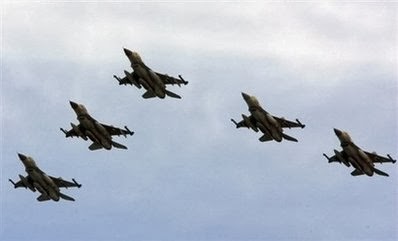 |
| Israeli fighter jets |
Israel has been gifted over two billion
dollars every year - most of it in the form of military “assistance” - by the
US for decades now. The Bush administration alone provided over 21 billion
dollars in “security assistance” during its time in office. In addition to
these lethal gratuities, Israel has more recently signed contracts with US arms
manufacturers for over 22 billion dollars of new military hardware. This
includes a deal for 75 Joint Strike Fighters, 9 military transport aircraft and
4 combat ships.
Israel presently has 180,000 heavily
armed regular troops in their armed forces, 140,000 conscripts, 4,300
impenetrable Merkava battle tanks, 10,000 light tanks and armoured cars, 500
missile-laden fighter jets, 1340 helicopters, three submarines, three
destroyers and 40 smaller warships. And the full might of Israeli military
force was projected into the tiny space of Gaza during the three week period
from December 27th 2008 to January 18th 2009.
In February 2009, investigative
journalist Conn Hallinan was to describe Gaza as "Death's Laboratory".
Israel’s new weapons had caused injuries never before seen in the hospitals of
Gaza. Many of these were the result of the widespread use of a new class of
weapons called Dense Inert Metal Explosive (DIME). These were initially
developed by the US Air Force and scientists from the University of
California’s Lawrence Livermore Laboratory nine years ago. DIME weapons consist
of a high explosive core around which is wrapped powdered tungsten alloy in a
carbon fibre container. On detonation, the tungsten sprays out explosively over
a ten-meter radius shredding everything in its field. The resultant injuries
are truly shocking.
 | |
| DIME weapon leg injuries |
Norwegian doctor Mads Gilbert
commented: “The muscles are sort of split from the bones, hanging loose, and
you also have quite severe burns. . . . Those inside the perimeter of this
weapon’s power zone will be torn completely apart. We have seen numerous
amputations that we suspect have been caused by this.” He went on to say, “I’ve
never seen anything as bad as that. I have been to many conflict zones. I was
in Beirut in 1982 . . . but Gaza was the worst.”
A German doctor working in southern
Gaza offered his own observations: “Initially, everything seems in order. . .
But it turns out on operation that dozens of miniature particles can be found
in all their organs.” Most of those who survive the shredding of their limbs
succumb soon after to septicaemia and organ collapse. Habas Al-Wahid, head of
emergency at a Gaza hospital observed that in several cases of DIME-caused
injuries, the legs of the injured were sliced from their bodies “as if a saw
was used to cut through the bone.”
Are these the intended fruits of human
ingenuity, of our capacity for deep intelligence, of our mastery of the art of
technological innovation?
The longer-term consequences of the use
of tungsten-based weapons have yet to be realised. Like depleted uranium, which
has caused numerous cancers and monstrous birth deformities in Iraq, aerosol
tungsten will doubtless bring its own train of future woe. Conn Hallinan
reports that it has already been implicated as a possible cause of leukaemia
and other cancers.
The DIME weapons used in Gaza were
either supplied directly to Israel by the US or were manufactured in Israel
under US instructions. They have yet to be banned under the Geneva Conventions
because - until Gaza - they had yet to be systematically “tested” on a living
population. Despite all pleas to the contrary and claims of good conduct by
Israel, the war upon Gaza, like all wars, was yet another act of profound
lawlessness and deceit.
 |
| Suspected white phosphorus burns, Gaza 2009 |
The use of phosphorus-based weapons
near populated areas has long been prohibited under international law. But this
did not prevent the use of such weapons by Israel. Suspicions were raised early
when, in addition to the hundreds of half-ton “conventional” bombs that rained
upon Gaza every day, the characteristic spray of burning white phosphorus
streaking through the sky began to be noticed in some of the airbursts. Within
a short time, people arrived in casualty wards of Gaza with horrible burns that
continued to smoke and smoulder even after they had been washed and bandaged.
During the first week of Israel’s offensive,
journalists from the UK Times identified row upon row of American-made
pale blue M825A1 white phosphorus artillery shells from high-resolution images
of Israeli artillery units on the Israeli-Gaza border. Their reports were met
with strident denials by IDF spokespersons. This echoed the Israeli denials
three years earlier of having used phosphorus against civilian targets in
Lebanon. They lied in August 2006 and they lied again in January 2009. But that
is all part of how war is conducted by civilised nations in obscene times.
On 11th January 2009, IDF
spokeswoman Major Avital Leibovich stated: “I can assure you we do not use any weapons that are
prohibited by international law. There are other nations that use phosphorus
bombs, and we have the right not to comment on this.” She was probably
referring to the fact that both Britain and the US used white phosphorus in
Iraq, especially during the Fallujah campaign. So the fact of one obscenity is
thereby used to justify another.
Another weapon used in Gaza was the
newly developed GPS-guided mortar. The GPS mortar was developed by the Israeli
weapons industry working closely with the US company Alliant. GPS mortars are
equipped with satellite navigation systems and are said to act with surgical
precision. Yet they were found sorely wanting. Israeli journalist Amira Hass reported
that during the second week of January, such a weapon missed its intended
target by 30 meters and slammed into a United Nations Relief and Works Agency
school where many women and children had sought refuge. It killed 30 of them
outright. Another 10 women and children died of their injuries later. Many
others sustained horrendous injuries.
After months of back-room negotiations,
the US agreed to supply Israel with 1,000 GBU-39 bombs in September 2008. These
new weapons had been developed and assembled by the Boeing Corporation. The
GBU-39 is designed to penetrate deep into the earth before exploding. Arrays of
these new weapons were delivered in early December. Within the first hours of
the Israeli offensive, hundreds of GBU-39 bombs had been dropped on Rafa in an
attempt to destroy the network of tunnels that enabled the movement of
essential goods and materials from Egypt into Gaza.
Cold Spin
The assault upon Gaza was many months
in the making. Steven Zunes reported in May 2009: “Israeli Defence minister Ehud Barak admitted that the Israeli
invasion had been planned for months, back when a six-month cease fire was
still in effect.”
Not a single Hamas rocket had been
fired into Israel from the time the cease-fire was declared on June 18th
2008 and the deadly truce-breaking Israeli air attack in Gaza on November 4th
2008 that killed six Hamas members. Steven Zunes observes that in spite of the
predictable and cynically anticipated resumption by Hamas of cross-border
rocket fire, “not a single Israeli had been killed by rocket attacks for more
than half a year prior to Israel launching its war on December 27.” The
planning for Operation Cast Lead was well under way in March 2008. It
was fully in place many months before the actual assault. The IDF was therefore
militarily well prepared for the December 27 assault. So too was its public
relations arm. Like the GBU-39 bombs at Rafa, silver-tongued commentators
miraculously and simultaneously appeared in the major media outlets throughout
the Western world.
In an impassioned piece entitled "Israel's Lies"
published in the London Review of Books on January 29th 2009, Henry
Seigman, former national director of the American Jewish Congress inveighed:
“Western governments and most of
the Western media have accepted a number of Israeli claims justifying the
military assault on Gaza: that Hamas consistently violated the six-month truce
that Israel observed and then refused to extend it; that Israel therefore had
no choice but to destroy Hamas’s capacity to launch missiles into Israeli
towns; that Hamas is a terrorist organisation, part of a global jihadi network;
and that Israel has acted not only in its own defence but on behalf of an
international struggle by Western democracies against this network.
I am not aware of a single major
American newspaper, radio station or TV channel whose coverage of the assault
on Gaza questions this version of events. . . Middle East peacemaking has been
smothered in deceptive euphemisms so let me state bluntly that each of these
claims is a lie.”
Those lies were swallowed up whole by
the Western world.
Even as the tanks began rolling and the
bombs were exploding, Israeli Foreign Minister Tzipi Livni instructed her
minions to engage foreign language speakers everywhere to take “emergency
measures to adapt Israel’s public relations to the ongoing escalation in the
Gaza Strip.” (Julia Irwin, “Getting Away with Murder”, Sydney Morning Herald,
11/1/09) Within hours, the smooth-voiced Israeli spokesman Mark Regev and
Martin Indyk, a former official of the American Israel Public Affairs
Committee, were everywhere to be heard on Radio National and the ABC network
throughout Australia.
UK journalist Robert Fisk happened to
be travelling through Canada at the time the offensive was launched. He noted
that numerous articles attempting to justify Israel’s actions by asking readers
to imagine the horror of coming under Palestinian rocket attack began to appear
simultaneously in large-circulation newspapers. He commented: “I’m
waiting for the same writers to ask how we’d feel if we . . . came under
sustained attack from supersonic aircraft and Merkava tanks and thousands of
troops whose shells and bombs tore 40 women and children to pieces outside a
school, shredded whole families in their beds and who, after nearly a week, had
killed almost 200 civilians out of 600 fatalities.”
US journalist Chris Hedges similarly railed: “The use of
attack aircraft and naval ships, part of the world’s fourth-largest military
power, to level densely packed slums of people who were hungry, without power
and often water, people surrounded on all sides by the Israeli army, was
fatuously described as a war. The news coverage held up the absurd notion that
a few Hamas fighters with light weapons and no organization were a counterforce
to F-16 fighter jets, tank battalions, thousands of Israeli soldiers, armoured
personnel carriers, naval ships and Apache attack helicopters. It fit the Israeli
narrative. It may have been balanced and objective. But it was not true.”
The attack upon Gaza was clearly part
of a longer-term project for the complete subjection of Palestinians by Israel.
The attack was not an act of self-defence against miserable Qassam rockets. As
Ben White pointed out:
“During the truce last year, rocket fire from the Gaza Strip was reduced by
97%, with the few projectiles that were fired coming from non-Hamas groups
opposed to the agreement.” The breaking of the ceasefire by the Israelis on
November 4th was a deliberate and provocative act that brought the
expected response from Hamas. The Israelis bided their time in order to teach
the Gazans a lesson for choosing Hamas during the 2006 elections. The ferocity
and the duration of Operation Cast Lead was intended to destroy Hamas
and to humiliate the Palestinians of Gaza who had deigned to chose Hamas as
their representatives.
Even before Operation Cast Lead, the Gazans were already near-broken by the
debilitating Israeli blockade of their border crossings. The compliant Mahmoud
Abbas and his shadowy Fatah officials had been sequestered into what is left of
the West Bank to make sure that the Palestinians there did not get too rowdy or
emotional about what was happening in Gaza. Most Western leaders chose to look
aside and chorused in unison about the Right of Israelis to Defend Themselves
while the Israeli military set about systematically destroying every civil
institution and every form of essential infrastructure necessary for the
conduct of life, a life that for Gazans had already been made near intolerable.
There are probably also other factors
behind Operation Cast Lead apart from the desire to destroy the will of
the Palestinians of Gaza and to “catastrophise” their experience of life. In a
more cynical vein, we would do well to remember that the Israelis have for many
years coveted the huge reservoirs of undersea natural gas in Gaza’s territorial
waters that were discovered by the British Gas Group about a decade ago. This
side of things may come increasingly to light in coming time as Israel attempts
to secure additional sources of energy during this time of dwindling reserves.
The Continuing Impasse
 |
| Gaza City, January 2009 |
During the 22 days of Operation Cast Lead, 20,000 buildings
and 5,000 homes throughout Gaza were completely destroyed leaving over half a
million metric tonnes of debris, much of which has yet to be cleared. The
Israelis targeted every part of the territory’s infrastructure. Erin Cunningham observed: “Homes,
businesses, factories, power grids, sewage systems and water treatment plants
were reduced to piles of rubble across the Gaza Strip.”
Seven schools in Gaza were totally
destroyed, and 135 were substantially damaged. The Al-Azhar University of Gaza
was reduced to rubble. Hospitals, medical clinics and Red Crescent warehouses
were all targeted, as was every police station and every building associated
with Hamas activities. Over 250 civilian Palestinian policemen were killed
during the 22-day operation. George Bisharat documents
how Israeli military lawyers went so far as to authorise the bombing of a
police cadet graduation ceremony, killing 63 young Palestinian men in a single
strike.
 |
| Missile Attack on Gaza Police Cadet Graduation Ceremony |
According to a particular view, Operation Cast Lead represented the face
of a new and compassionate style of warfare where the dead are counted in the
thousands rather than tens or hundreds of thousands; where the entire
population is reduced to immiserated subjection rather than starvation unto
death; where all the institutional forms necessary for the conduct of civil
society are broken apart rather than being totally incinerated and destroyed;
where all such actions are claimed to be fair and just and necessary for
self-protection.
Among the first to speak loudly and
passionately about the criminality of Israel’s actions was Richard Falk, UN
special rapporteur on the Palestinian territories. As the first Israeli bombs
exploded on December 27th, Falk drew attention to the massive
violation of international humanitarian law that was happening in Gaza. He
called upon the United Nations to halt Israel’s actions and to immediately
provide protection for the Palestinian people. But for decades now, neither the
wishes nor the resolutions of the United Nations have tempered the actions of
Israel towards Palestinians. Falk was later to write:
“The focus of legal debate should
not be upon whether Israeli force was disproportionate. Of course it was. The
focus should be on whether the Israeli attacks were a prohibited non-defensive
use of force under the UN charter, amounting to an act of aggression, and as such,
constituting a crime against peace. . . .
Israel initiated the Gaza campaign
without adequate legal foundation or just cause, and was responsible for
causing the overwhelming proportion of devastation and the entirety of civilian
suffering” (Le Monde Diplomatique, 12/3/09).
Soon after, George Bisharat, professor
of Law at the University of California published a series of articles in US
newspapers detailing how international law had been brutalised by Israel in its
22-day assault upon Gaza. He describes how Israeli lawyers deliberately
manipulate legal process to achieve their desired ends. Quoting Daniel Reisner,
former head of Israel’s 20-lawyer International Law Division in the Military
Advocate General’s office, he showed how powerful lawyers acting in concert can
effectively change the rules:
“If you do something for long
enough, the world will accept it. The whole of international law is now based
on the notion that an act that is forbidden today becomes permissible if
executed by enough countries. . . . International law progresses through
violations. We invented the targeted assassination thesis and we had to push
it. At first there were protrusions that made it hard to insert easily into the
legal molds. Eight years later, it is in the centre of the bounds of
legitimacy” (“Israel: Transforming International Law by Violating It”, San
Francisco Chronicle, 1/4/09).
Yet there are some lawyers who are more
driven by ethical considerations than a will to serve political ideologies. In
early February 2009, a group of eight American lawyers, all members of the
National Lawyers Guild in the US visited and reported on their observations of
the situation in Gaza. They confirmed that the IDF had fired missiles at UNRWA
schools in Gaza City, Jabalyia and Bet Labiya. They expressed deep concern at
the use of white phosphorus, DIME munitions and other prohibited weapons and at
“the use of conventional weapons in a prohibited manner, specifically, the use
of battlefield weapons in densely populated civilian areas.”
All eight members of the Delegation
called upon both Israel and the US - which supplied most of the weapons used in
the assault – to be held accountable for the criminality of their actions.
Remembering Gaza
The horror of Gaza cannot be dismissed
as a distant phenomenon that does not concern us. We may withdraw into our own
complacency and comfort, but in truth, no one is exempted from the pain visited
upon innocent households. No one can evade the consequences of the destructive
exercise of brutal force.
The immense yet subdued anguish, the
heavy-hearted impotence that weighs on so many, the outraged sense of justice
at the grotesque disproportionality of the violence we have witnessed, the
travestying of all norms of reasonable human conduct will neither pass nor be
forgotten.
The assault upon Gaza has done nothing
to further the making of peace in Palestine. It has done much to deepen
resentments that will find their own tragic and futile expressions in time to
come. No cheek has been turned at any stage in the volleys of violence that
have shaken the Holy Land for more than half a century. And little regard has
been given to the humanity of the generations swept into a gathering maelstrom
fired by a cold and calculated demonic determination.
There is more that could be said, and
more, perhaps, that should be said about how the people of Gaza have been
manacled since 1993 when Israel closed the borders and “managed” the movement of
people and goods into and out of Gaza; about the 44 year long occupation of
Gaza, the West Bank and East Jerusalem; about the wholesale separation and
isolation of the Palestinians of Gaza from their fellow Palestinians in the
West Bank; about the progressive cantonisation of the West Bank by the
relentless construction of militarily-protected illegal “settlements”; about
the “security barriers” that have drawn and quartered any semblance of
autonomous life and culture for all Palestinians; about the forced
impoverishment, reduced access to markets, and forfeited freedoms of all
Gazans. The betrayal of Gaza represents not only a failure of justice, but also
a failure of the human spirit.
Let us continue to remain vigilant
regarding further movements in the Middle East as the seams that hold the
phenomenal world together everywhere begin to stretch to their limits.
Notes
1. In his speech “Palestine: a Challenge to Humanity”
delivered at Berkeley in 2004, and recorded by Maria Gilardin of TUC Radio, Mustafa Barghouthi, graphically describes life
in Gaza and the West Bank under the policies of Ariel Sharon. Little has
changed for the Palestinians during the past six years. Barghouthi speaks both
as statesmen and as medical practitioner who has seen too many mothers, fathers
and children torn apart by fierce weaponry
2. Edward Said was among the clearest of voices alerting us
all to the plight of the Palestinians. His passionate advocacy for the
Palestinian cause and his luminous intelligence are fully evident in a lecture
presented at the University of California at Berkeley in February 2003 on the
eve of the US invasion of Iraq. This was the last major speech that Edward Said
gave before his death. It was can be accessed here.
3. Political economist and long-time
associate of Edward Said, Sara Roy offers a poignant and powerful portrait of
the plight of Gazans in a lecture given at the University of Sydney in October
2008. A podcast is available here.
4. The plight of the people of Gaza
continues unabated despite a commitment by the Israeli Government on June 20th
2010 to ease its illegal blockade of Gaza. Yet very little has actually changed
during the time since that commitment was made. For those who would maintain a continuing awareness of the reality lived by the inhabitants of Gaza, Eva Bartlett provides a highly informed watching brief through her powerful blog, In Gaza.


